
Joseph E. Rockey Jr.
Solving complex business problems organizations often consider unsolvable—or simply accept as a cost of doing business.
Joseph's work is built around a simple belief: most business problems become easier to understand when you stop staring at the symptom and examine the relationships underneath it.
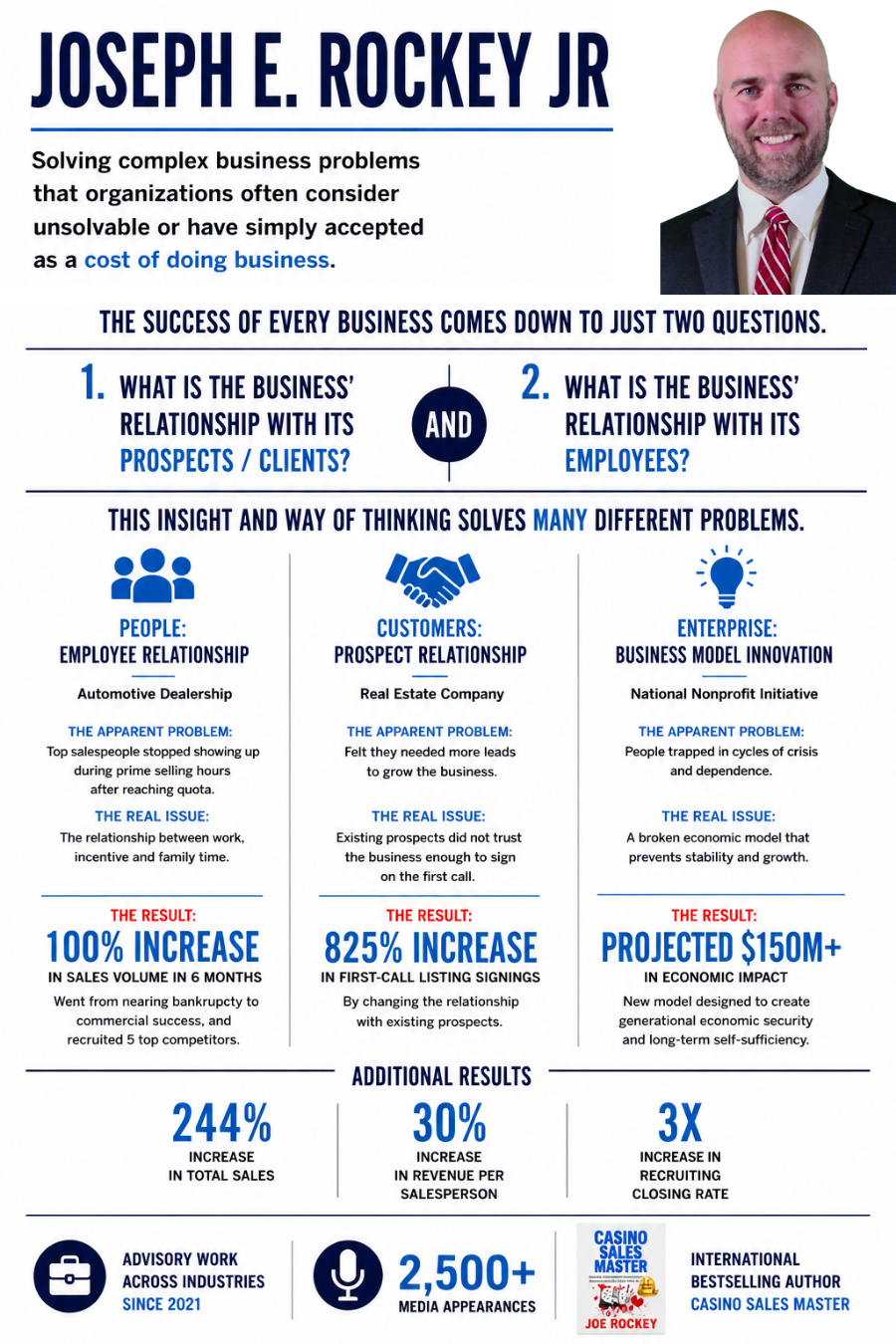
The success of every business comes down to two questions.
What is the business's relationship with its prospects and clients?
What is the business's relationship with its employees?
Different industries. Different symptoms. The same habit of finding the real problem.
These examples show how the same way of thinking has been applied to employee relationships, prospect relationships, and enterprise-level business models.
An automotive dealership changed the relationship between work, incentives, and family time. The business moved from nearing bankruptcy to commercial success.
A real estate company believed it needed more leads. The deeper issue was that existing prospects did not trust the business enough to sign on the first call.
A current national nonprofit initiative was designed around a new economic model intended to create long-term stability and self-sufficiency.
A difficult market had become the accepted explanation for performance. Changes to communication, motivation, and incentives changed the result.
A six-month seasonal dead period was reduced to three months while the organization attracted experienced talent.
Changes to culture, communication, and incentive design affected the company's ability to attract and close talent.
The owner-independence idea is personal.
Joseph has had 29 businesses. That scale only becomes possible when businesses are successfully sold or built to function without the owner being required in the day-to-day operation.
That lived experience is the foundation for the work.
Elite Business Conversations is not centered on teaching owners how to squeeze more productivity out of themselves. The work is centered on making the company less dependent on them.
Business creation, advisory work, publishing, and media.
Joseph is an international bestselling author of Casino Sales Master: Proven System to Beat the Odds in Sales and Life and has appeared in more than 2,500 media appearances.
His work spans business creation, consulting and advisory work, sales, employee engagement, prospect conversion, business-model innovation, and the practical problems that emerge when an organization becomes too dependent on one person.
What makes the background transferable
It is not one industry playbook. It is pattern recognition across employee behavior, prospect trust, incentives, recruiting, revenue, culture, and business-model structure.
The goal is to identify what the organization has accepted as normal, determine whether that explanation is actually true, and find a better structure when it is not.